No products in the cart.: ₹0.00


By alloytek
0 Comments
How do you lock two doors that close against each other, with no fixed frame in the middle? That is the puzzle every pair of doors poses, whether it is a grand main entrance, a living room opening onto a balcony, or a pooja room with twin carved shutters. A single door locks into its frame. A pair has to lock into itself. The answer is a double door mortise lock working together with flush bolts, and getting the arrangement right is what makes a pair of doors feel as solid as one.
How a double door mortise lock works
In a pair of doors, one leaf is used every day and the other usually stays shut. The everyday door is called the active leaf. The other is the passive leaf, sometimes called the inactive or standing leaf. The double door mortise lock goes into the active leaf, and its latch and deadbolt throw into a strike fitted on the edge of the passive leaf rather than into a frame.
That means the passive leaf has to be held firmly in place itself, or the active leaf is simply locking against something that can swing open. This is where flush bolts come in. Alloytek’s MLL110 double door lockset is built for double doors, so plan the flush bolts alongside it and the lock body, strike and handles will work together across both leaves.
The passive leaf and flush bolts
A flush bolt is a sliding bolt set into the edge of the passive leaf, usually one at the top and one at the bottom. The top bolt shoots up into the head of the frame, and the bottom bolt drops into a socket in the floor or threshold. With both bolts engaged, the passive leaf is fixed in place at two points, and the active leaf locks against it with confidence.
Because flush bolts sit within the door edge, they are hidden when the doors are closed and do not spoil the look of the pair. Fit the floor socket carefully. On marble or granite floors, ask the fitter to drill a neat hole and set a proper keeper so dust and water do not collect. On the head of the frame, make sure the keeper is screwed into solid timber, not just a thin moulding.
There is a common shortcut worth avoiding. Some installations fit only a top bolt, or use a surface bolt on the face of the door. A single bolt leaves the bottom of the passive leaf free to flex, and a surface bolt is visible and easier to tamper with. Two concealed flush bolts are the better standard for any pair of doors that needs real security.
Choosing the rebate and the right lockset
Pairs of doors meet in one of two ways. In a rebated pair, the meeting edges are stepped so one overlaps the other, which closes the gap against light, draughts and prying tools. In a flat pair, the edges simply meet face to face, often with a separate astragal strip covering the joint. The lock body and strike have to suit whichever you have. A rebated lock, with a stepped faceplate, is used on rebated doors, while a flat faceplate suits square edges.
Measure door thickness, stile width and the depth of the rebate before ordering. Check the backset so the handles on the active leaf sit comfortably away from the meeting edge. On a main double door, consider a heavier lock body, with a longer deadbolt throw or more bolts, because double doors are wider and give more leverage to anyone trying to force them.
Handles, finishes and everyday use
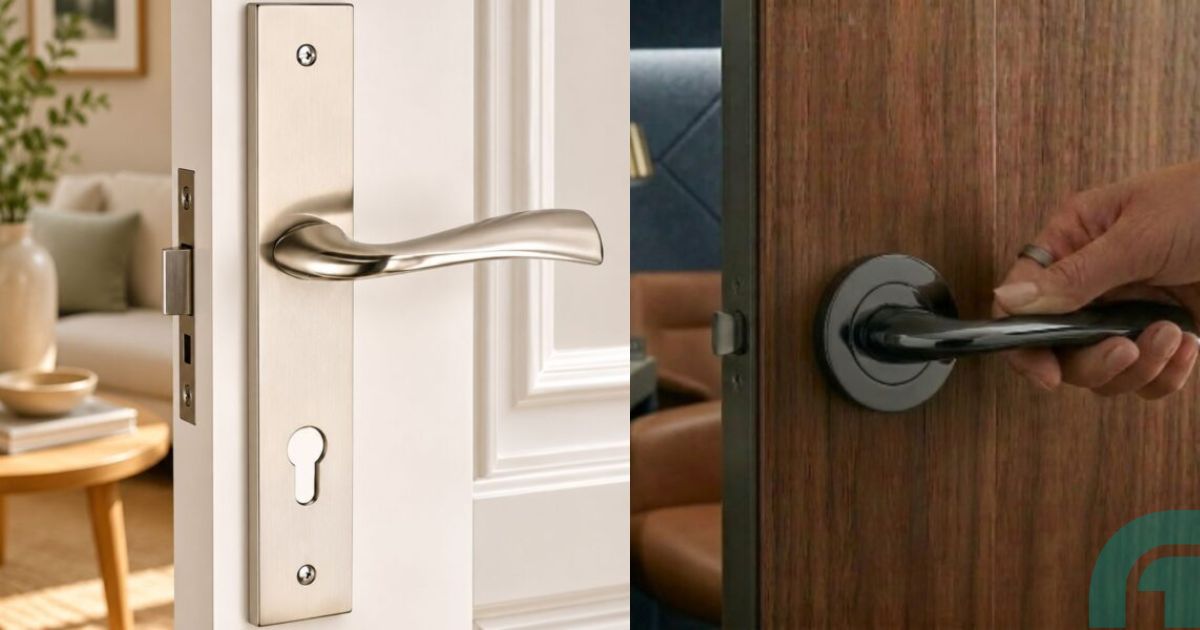
The active leaf carries the working handles, on both sides of the door. Many people also fit a matching dummy handle or pull handle on the passive leaf so the pair looks balanced. Make sure the dummy is clearly fixed, so nobody tries to open the passive leaf by pulling on it while the flush bolts are engaged.
Choose a finish that matches the rest of the house and stands up to the setting. Balcony doors face sun and monsoon rain, so SS, black or a well-plated antique finish makes sense. A main entrance with carved teak doors may suit a brass mortise handle in an antique or rose gold tone. A door stopper on each leaf protects walls and stops handles hitting furniture when the pair is opened wide for a function. When locking up, the passive leaf should be closed and both flush bolts thrown before the active leaf is shut, so the latch on the active leaf always meets a fixed edge.
Also read
Call to action
Planning a pair of main doors, balcony doors or a twin-leaf pooja room? Alloytek manufactures double door mortise locks and locksets, mortise handles in brass and zinc, and door stoppers in Aligarh, with more than 50 years of manufacturing and over 1,000 products in its range. Call or WhatsApp +91 79009 79006, or visit the Alloytek works at C-164-166, Sector-1, Talanagari, Aligarh-202001. Dealers can see the Become a Dealer page on the Alloytek website.

alloytek