No products in the cart.: ₹0.00

By alloytek
0 Comments
Why do so many new homes end up with a handsome handle that rattles on its spindle, or a key that has to be jiggled after the first monsoon? Most of the time the handle is not the problem. The lock body hidden inside the door was picked separately, by someone else, often at a different shop. Designer mortise locks only look and feel right when three things are decided as one set, the lock body, the handle on top of it, and the door it has to live in. Get that pairing right and the hardware disappears into daily life. Get it wrong and you notice it every single day.
Start with the door, not the catalogue
The door decides more than people expect. A solid wood or engineered main door around 40 to 50 mm thick can take a full-size mortise lock body with room to spare on either side of the pocket. A lighter internal flush door, or a hollow-core bedroom door, has far less timber to cut into, so a compact body is the safer choice. Cutting a deep, wide pocket into a thin stile weakens the edge, and that weak edge is exactly where the strike takes every slam.
Note which way the door swings and which side the hinges sit. Most quality mortise lock bodies are reversible, but the handle you like may come in a left or right hand version, and some lever shapes look odd when flipped. Also check the backset, the distance from the door edge to the centre of the handle spindle. A wide stile with a short backset pushes the handle too close to the frame, and knuckles start meeting the architrave.
Match the mortise lock body to the room’s job
A main entrance, a bathroom and a store room all need different things from the same family of hardware. For the front door, an entrance lockset with a latch plus a key-operated deadbolt makes sense, and for larger or more exposed doors a heavier body with more bolts is worth the extra cost. Bedrooms usually want a privacy function, where a turn on the inside locks the door and the outside can still be opened in an emergency. Bathrooms add the reason for an indicator so nobody rattles the handle. Double doors need a lock set up for an active and a passive leaf.
This is where a coordinated range helps. When the entrance, privacy, double door, lever dead, euro dead and 4-bolt bodies all come from one maker, the handle fixing points and spindle sizes line up across the house. Alloytek’s mortise locks and locksets cover exactly these functions, which is why architects often specify one family room by room instead of mixing brands.
Choosing the mortise handle style that suits the body
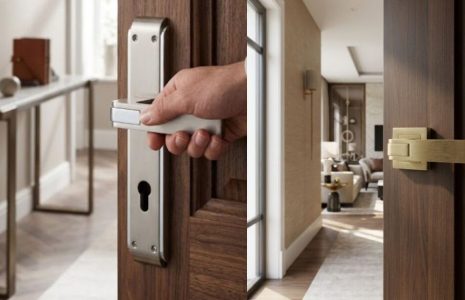
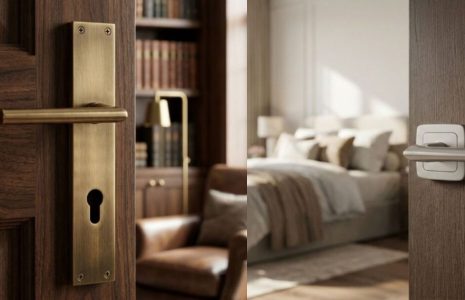
Handles on a plate and handles on a separate rose behave differently. A long plate handle covers the keyhole and both fixing screws in one piece, which hides small errors in the door cut and suits traditional or heavily carved doors. Rose-mounted levers with a separate keyhole escutcheon look lighter and more contemporary, but they demand a cleaner cut because every hole shows.
Weight matters too. A solid brass mortise handle feels substantial and wears in nicely over the years. A zinc alloy handle can carry sharper, more sculpted shapes at a friendlier price and takes plating well. Neither is wrong. What matters is that the spring inside the lock body is matched to the handle’s weight, so a heavy lever returns to level instead of drooping a few degrees after a year. Ask about this before ordering, because a drooping lever is the most common complaint people bring back to a hardware dealer.
Finishes that hold up in Indian conditions
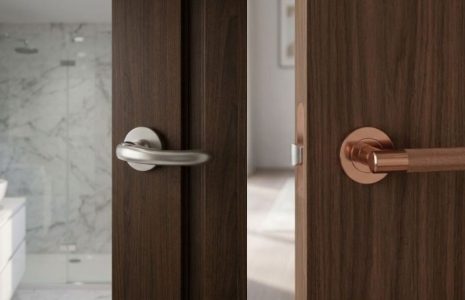
Coastal humidity, dusty summers and harsh floor cleaners all take a toll on hardware. Stainless steel (SS) finishes shrug off moisture and are easy to wipe. Antique finishes hide fingerprints and age gracefully on wooden doors. Black reads sharp against light laminates and pale walls, while rose gold (RG) adds warmth to bedroom and wardrobe doors. Whichever you pick, keep the finish consistent within a sightline. A rose gold lever beside an antique hinge on the same door looks like a mistake, even if each piece is good on its own.
There is a mild disagreement worth airing here. Many people choose the finish first and then hunt for a lock that matches. It is better to settle the lock function and body size first, then choose the finish from what that range offers. A finish can be refreshed. A wrong lock body means a new pocket in the door.
A quick pairing check before you order designer mortise locks
Before the order goes in, run through a short list with your carpenter or site engineer. Confirm door thickness and material, the backset that suits the stile, the hand of the door, the function each room needs, and the handle type, plate or rose. Then ask the supplier whether the handle and the lock body share the same spindle size and fixing centres, and whether the lever spring suits the handle’s weight. Five minutes on this saves a door from being cut twice.
For builders handling dozens of flats, it also helps to lock one body size and one handle fixing pattern across all units. Spare parts become interchangeable, and the maintenance team only needs to learn one system.
Also read
Talk to Alloytek
Alloytek has been manufacturing architectural hardware in Aligarh for more than 50 years, with a range of over 1,000 products, from mortise handles in brass and zinc to full mortise locksets for every room. If you are planning a home, a housing project or a dealer order, call or WhatsApp +91 79009 79006, or visit the Alloytek works at C-164-166, Sector-1, Talanagari, Aligarh-202001. Dealers looking to stock the range can also use the Become a Dealer page on the Alloytek website.